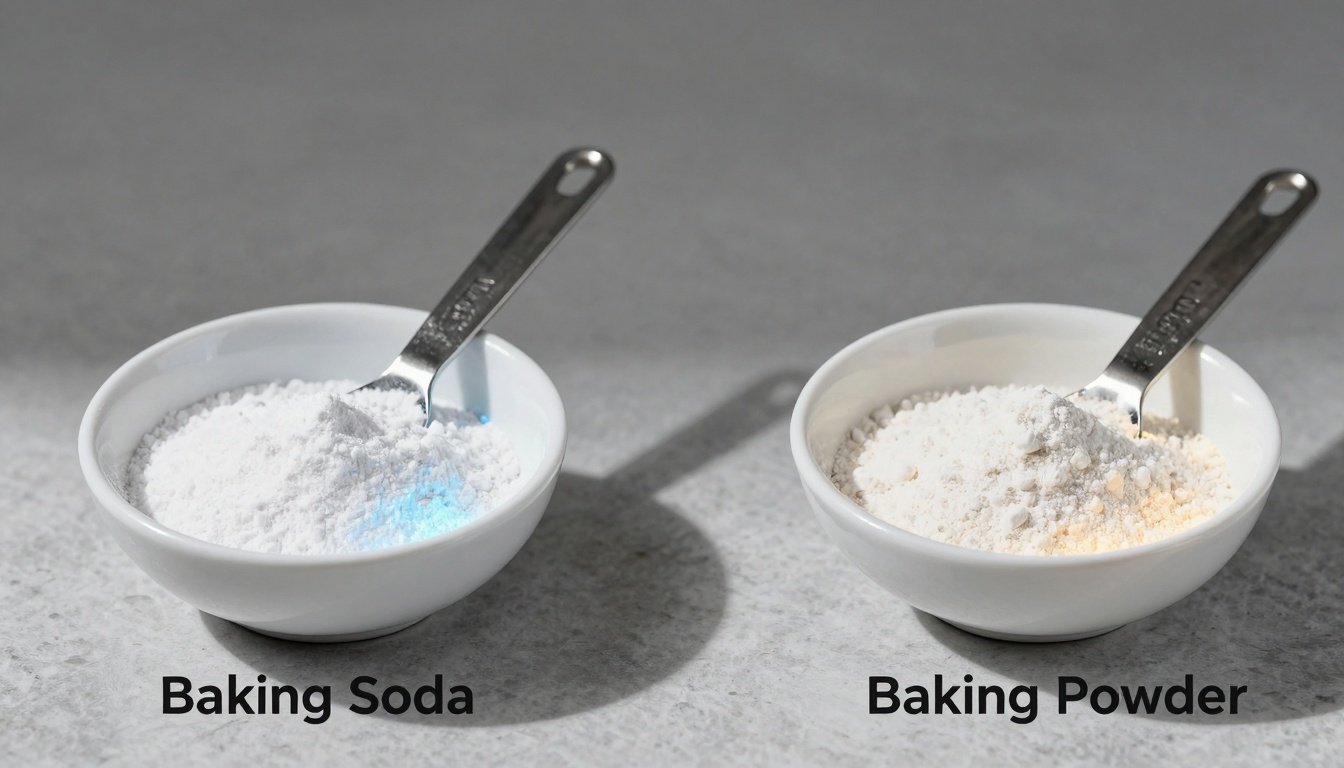
Have you ever pulled a tray of cookies from the oven, only to find them flat and sad? Or baked a cake that sank like a stone? These baking disasters often come down to one simple mix-up: confusing baking soda with baking powder. Many home bakers grab the wrong one from the cupboard, thinking they’re the same. But they’re not.
Leavening agents like these two are key in baking. They create bubbles of gas that make dough or batter expand. Without them, your treats would be dense and tough. In modern baking, you can’t skip them – they turn basic mixes into fluffy delights.
Understanding Baking Soda: Pure Sodium Bicarbonate
Baking soda stands out as a basic ingredient in any kitchen. It’s simple, pure, and powerful when used right. Let’s dive into what makes it tick.
What is Baking Soda Chemically?
Baking soda is just sodium bicarbonate, written as NaHCO₃. This compound has an alkaline nature, meaning it’s a base. It sits on your shelf as a white powder, waiting for action.
To work, baking soda needs an acid. Think buttermilk, yoghurt, or even a splash of vinegar. When mixed with liquid and acid, it breaks down fast. This reaction releases carbon dioxide gas, or CO₂, right away. Those bubbles lift your batter or dough.
Without acid, baking soda does nothing much. It’s like a spark that needs fuel to ignite.
Common Household Uses Beyond Baking
Baking soda isn’t just for cakes. You can sprinkle it in the fridge to soak up smells. Or mix it with water for a gentle scrub on pots and pans.
For cleaning, try it on greasy ovens. Dampen the powder, spread it on, and let it sit before wiping. It cuts through grime without harsh chemicals.
Unlike baking powder, which stays in the baking world, baking soda pops up everywhere. It’s that one jar you reach for in a pinch, from freshening shoes to soothing bug bites.
Actionable Tip: How to Test if Your Baking Soda is Still Active
Old baking soda loses its punch. It won’t create enough gas, leaving your bakes flat.
To check, drop a teaspoon into a bowl with two teaspoons of vinegar. If it fizzes and bubbles, it’s good to go. No reaction? Toss it out.
Freshness matters because expired agents fail to leaven. Keep your soda in a cool, dry spot, and test every six months.
Decoding Baking Powder: The Complete Leavening System
Baking powder feels like a ready-made team. It has everything it needs built in. No extra steps required.
The Composition of Baking Powder
This leavener mixes sodium bicarbonate with an acid, often cream of tartar. Cornstarch joins in as a filler. The starch keeps things dry until you add liquid.
That acid part reacts with the base inside the powder. No need to hunt for buttermilk or lemon juice. It’s all there in one scoop.
Compared to baking soda, baking powder is self-contained. You add it to neutral mixes, like plain flour and milk, and it handles the rest.
Single-Acting vs. Double-Acting Powder
Not all baking powders act the same. Single-acting ones react fully when you stir in liquid. The rise happens quickly, before baking.
Double-acting is more common today. It kicks off a bit when wet, then ramps up in the oven’s heat. This gives a steady lift, perfect for most home bakes.
Check your tin – most say “double-acting.” Recipes assume this type for the best results.
When to Use Baking Powder: Recipes Requiring Neutral pH
Reach for baking powder in cakes with regular milk or water. It works without extra acid.
Quick breads, like banana loaf with plain ingredients, I love it. Muffins for breakfast? Same deal – even rise, no fuss.
These recipes stay at a neutral pH. Baking powder keeps the balance, avoiding any sour notes.
The Crucial Chemical Reaction: Acid-Base Interaction
At heart, both agents rely on acid and base mixing. But the timing changes everything.
Speed of Reaction and Final Texture
Baking soda reacts in a flash with acid. CO₂ bubbles form fast, pushing the dough up quickly. If your oven isn’t hot yet, that rise can drop, leading to dense results.
Baking powder, especially double-acting, spreads the action. First in the bowl, then more in the heat. This controlled release means better oven spring – that final puff in the oven.
Those gas bubbles stretch the gluten in flour. You get light, airy textures, like in fluffy scones or tall biscuits.
Impact on Flavour Profile
Leftover baking soda can taste off. That soapy or bitter edge comes from unreacted base. Always pair it with enough acid to neutralise.
In chocolate cake, cocoa acts as an acid. With baking soda, you get a tender crumb and rich flavour, no metallic tang.
Baking powder keeps things mild. It suits vanilla cupcakes where you want pure sweetness shining through.
Substitution Guidelines: Can I Swap Them?
Swapping works in a bind, but it’s not always perfect. Know the rules to avoid flops.
Substituting Baking Powder for Baking Soda (and Why It’s Tricky)
Use three times as much baking powder as soda. So, one teaspoon of soda becomes three of powder.
The catch? You’re adding extra acid and starch. In acidic recipes, like gingerbread with molasses, it might not lift enough. The balance tips, and your bake could turn flat or dense.
Test small batches first. For a chocolate chip cookie dough with yoghurt, this swap might dull the tang you want.
Substituting Baking Soda for Baking Powder (The Acid Requirement)
For one part baking powder, use one part soda plus two parts acid. Say, half a teaspoon of soda and one teaspoon of cream of tartar.
Liquid acids like lemon juice or vinegar count too – one teaspoon per half teaspoon soda. But cut back on other liquids in the recipe. Too much moisture makes the batter runny.
This keeps the reaction going without soggy results. In a pinch for scones, add vinegar to milk for quick buttermilk.
Real-World Application: Recipe Scenarios
Recipes hint at which to use. Let’s look at three common ones.
Scenario 1: Buttermilk Pancakes (Soda Required)
Buttermilk brings acid to the party. Baking soda reacts with it for tender, golden pancakes.
The fizz helps them brown nicely on the griddle. Without soda, they’d stay pale and heavy.
Mix one teaspoon of soda with a cup of flour and buttermilk. You’ll see the bubbles form as you stir.
Scenario 2: Self-Rising Flour Baked Goods (Powder Implied)
Self-rising flour has baking powder baked in – about one and a half teaspoons per cup. No need to add more.
Check the pack to confirm. Use it for easy cornbread or biscuits, and skip extra leaveners.
This saves time, but don’t double up. Too much powder leads to a bitter aftertaste.
Scenario 3: Brownies (Minimal Leavening)
Fudgy brownies want chew, not height. A pinch of baking powder – or none – keeps them dense.
The goal is crackly tops and gooey centres. Extra lift would make them cakey, not brownie-like.
In recipes with chocolate’s natural acid, a touch of soda enhances flavour without much rise.
Conclusion: Mastering Your Leavening Agents
Baking soda needs acid to shine – it’s a pure base, ready for reaction. Baking powder is the all-in-one kit, often double-acting for a steady lift.
Grasp these differences, and your bakes will soar. Always peek at your recipe’s ingredients to match the chemistry.
Next time you bake, choose wisely. Your kitchen will thank you with perfect, fluffy treats. Grab that apron and experiment – happy baking!