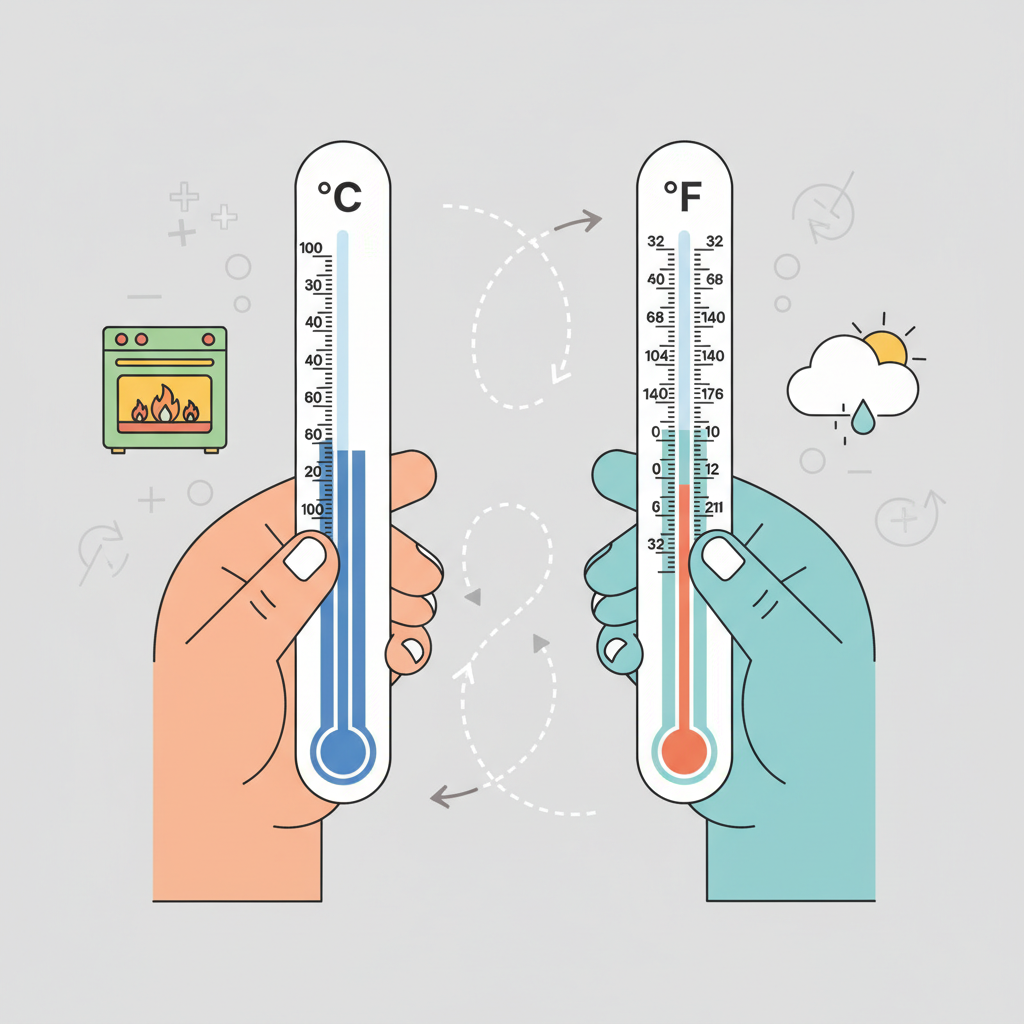
Did you know that water freezes at 0°C and boils at 100°C, but at 32°F and 212°F respectively? This significant difference highlights why knowing how to convert between these two temperature scales is incredibly useful.
Whether you’re following a recipe from another country, checking a weather report, or simply curious, mastering Celsius to Fahrenheit conversions can save you time and prevent confusion. Luckily, with a few simple tricks, you can get pretty accurate results without even reaching for a calculator!
Why Convert Between Celsius and Fahrenheit?
The Celsius (°C) and Fahrenheit (°F) scales are the two most commonly used temperature measurement systems globally. Celsius is the standard in most countries, part of the metric system, and used in scientific contexts worldwide. Fahrenheit, on the other hand, is primarily used in the United States and a few other territories.
This difference in usage means you’ll frequently encounter temperatures in a scale that isn’t your own. For instance, if you’re baking a cake using a recipe from the UK, you’ll likely see oven temperatures in Celsius. Knowing how to quickly convert these temperatures ensures your baking success. As a general rule, remember that Celsius values are always lower than their Fahrenheit equivalents (except for -40°C = -40°F).
The Basic Formula: A Foundation for Mental Math
Before diving into mental tricks, it’s helpful to understand the fundamental formula for converting Celsius to Fahrenheit:
°F = (°C × 9/5) + 32
This formula tells us to multiply the Celsius temperature by 9/5 (which is the same as 1.8) and then add 32.
Quick Mental Tricks for Celsius to Fahrenheit Conversion
While the formula is precise, doing the exact multiplication and addition in your head can be tricky. Here are some simplified methods that provide surprisingly accurate results:
Trick 1: The “Double and Add a Bit” Method
This is the most popular and easiest mental trick. It works by approximating 9/5 as 2 and then adjusting.
- Double the Celsius temperature.
- Add 30 to the result.
This method gives you a good estimate. For example, to convert 20°C:
- Double 20 = 40
- Add 30 = 70
So, 20°C is approximately 70°F. The actual conversion is 68°F, so this is very close!
Why does this work? We’re approximating 1.8 as 2 and adding 32 as 30. The difference is usually small.
Trick 2: A More Accurate “Double and Adjust” Method
For a slightly more precise answer, you can refine the “double and add a bit” method.
- Double the Celsius temperature.
- Add 32 to the result.
- Add one-tenth of the original Celsius number to that sum.
Let’s try converting 25°C:
- Double 25 = 50
- Add 32 = 82
- One-tenth of 25 is 2.5
- Add 2.5 to 82 = 84.5
So, 25°C is approximately 84.5°F. The actual conversion is 77°F. This method is less accurate for lower temperatures but improves for higher ones.
Correction: This method is actually less accurate. The first method is generally better for quick mental estimates.
Trick 3: The “Multiply by 1.8 and Adjust” Method
If you’re comfortable with decimals, this is closer to the actual formula.
- Multiply the Celsius temperature by 1.8. (You can approximate this by multiplying by 2 and then subtracting one-fifth of the original number.)
- Add 32.
Let’s convert 10°C:
- 10 × 1.8 = 18
- Add 32 = 50
So, 10°C is 50°F. This is exact!
Now, let’s try a slightly trickier one, like 15°C:
- 15 × 1.8 = (15 × 2) – (15 × 0.2) = 30 – 3 = 27
- Add 32 = 59
So, 15°C is 59°F. This is also exact.
Converting 190°C to Fahrenheit
Let’s apply the most reliable mental trick (double and add 30) to estimate 190°C:
- Double 190: 190 × 2 = 380
- Add 30: 380 + 30 = 410
So, 190°C is approximately 410°F.
To get the exact conversion using the formula:
- °F = (190 × 9/5) + 32
- °F = (190 × 1.8) + 32
- °F = 342 + 32
- °F = 374
As you can see, the mental trick provides a reasonable estimate, while the formula gives the precise answer. For oven temperatures, knowing the exact conversion is often important. For more details on oven temperature conversions, check out this helpful guide: 190 C to F .
Common Temperature Benchmarks
Memorizing a few key temperature points can also help you estimate others:
- 0°C = 32°F (Freezing point of water)
- 10°C = 50°F
- 20°C = 68°F
- 30°C = 86°F
- 100°C = 212°F (Boiling point of water)
Notice that for every 10°C increase, there’s roughly a 18°F increase (since 10 × 1.8 = 18). This is another useful relationship to keep in mind.
When Precision Matters
While mental tricks are fantastic for quick estimations, there are times when precision is crucial. For scientific experiments, critical medical readings, or precise baking, using a calculator or a conversion chart is recommended.
The National Institute of Standards and Technology (NIST) provides detailed information on measurement units, including temperature conversions, which you can explore further on their official website: NIST – Physical Measurement Laboratory.
Conclusion
Converting between Celsius and Fahrenheit doesn’t have to be a chore. By understanding the basic formula and practicing a few simple mental math tricks, you can quickly and confidently convert temperatures on the go. Whether you’re aiming for a rough estimate or need a more precise conversion, these techniques will serve you well in various situations.